
Dental Implants
Permanent Dental Implants at Affordable Prices
Restore missing teeth with expert-placed implants using high-quality material.
Starting at Rs. 15000

What are Dental Implants Used for?
Dental implants offer many benefits for people who have lost teeth or need to replace damaged ones. One of the biggest advantages is their natural look and feel, as implants closely resemble real teeth and enhance both your smile and overall facial appearance. They allow for clear speech without the worry of slipping or shifting, and because they are fixed in place, they offer far greater comfort and stability than removable dentures. Implants also function like natural teeth, letting you enjoy your favorite foods without restrictions and boosting confidence with a complete, natural-looking smile.
Another major benefit of dental implants is their long-term impact on oral health. As a permanent solution, implants fuse with the jawbone, helping to stimulate bone growth and prevent bone loss after tooth loss. This preserves the natural jaw structure and prevents surrounding teeth from shifting out of position. With proper care, dental implants are highly durable and can last for many years. Unlike dental bridges, implants do not require adjacent teeth to be ground down, helping preserve natural teeth. They also do not decay, and there is no need to remove them for cleaning, making them a convenient and reliable tooth replacement option.
Types of Dental Implants

Osstem/Neobiotech Implants
Starting at Rs. 15000
These implants are perfect for people who are missing one or a few teeth. They are surgically inserted into the jawbone and consist of a titanium post that serves as an artificial tooth root. This post supports a custom-made crown that looks and functions like a real tooth. Single tooth implants provide stability, help prevent bone loss, and fit perfectly with the surrounding teeth.

Straumann Dental Implants
Starting at Rs. 22000
Straumann implants offer a premium solution for dental restoration. Known for their precision, they integrate seamlessly with the jawbone, providing a strong foundation for crowns, bridges, or dentures. Designed with advanced technology, these implants ensure stability and promote bone preservation. Each implant is custom-made to match your natural teeth, delivering a lifelike appearance.
All-on-2 Dental Implants
Starting at Rs. 55000
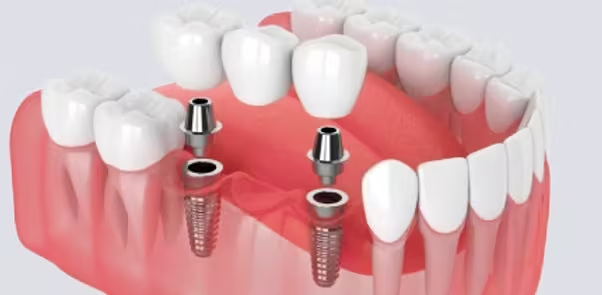
The All-on-2 dental implant system is designed to support an entire arch of teeth using just two strategically placed implants. This approach is ideal for patients with significant tooth loss, offering a stable and durable solution. By utilizing only two implants, the All-on-2 system minimizes the need for extensive surgery while maximizing support for the full arch prosthesis. It effectively restores function and aesthetics, making it a practical choice for long-term dental rehabilitation.

All-on-4 Dental Implants
Starting at Rs. 95000
This method is suitable for people who are missing most or all of their teeth in one or both jaws. The All-on-4 technique involves placing four implants into the jawbone to support a full arch of prosthetic teeth. This approach makes the most of the existing bone, often reducing the need for bone grafting. It also allows for the immediate fitting of a temporary set of prosthetic teeth on the same day as the surgery.
Benefits of Dental Implants vs. Risks of Avoidance
Benefits of Dental Implants
- Mimic natural teeth in appearance and function.
- Prevent jawbone deterioration.
- Maintain the alignment of adjacent teeth.
- Enhance speech and chewing ability.
- Offer a durable, long-term solution to tooth loss.
Risks of Not Getting Dental Implants
- Continued bone loss in the jaw.
- Shifting of remaining teeth, leading to misalignment.
- Difficulty in chewing and speech.
- Potential for facial structure changes.
How do Dental Implants compare to Dentures?
| Comparison | Dental Implants | Dentures |
|---|---|---|
| Bone Health | Helps preserve bone health and prevents bone loss. | May lead to bone decline over time. |
| Procedure | Involves a surgical process for placement. | Non-surgical, simpler procedure for placement. |
| Cost | High initial cost but long-term investment. | Generally lower cost but may need more frequent replacement. |
| Maintenance | Easy to maintain with regular brushing and flossing. | Requires more maintenance and regular cleaning. |
| Appearance | Implants look very natural and blend with other teeth. | Dentures’ appearance can vary and may look artificial. |
| Stability | Implants provide high stability and do not shift in the mouth. | Dentures can be less stable and may move around. |
| Comfort | Dental implants offer high comfort with no irritation. | Dentures provide moderate comfort with potential irritation. |
Dental Implant Procedure
The process of placing a dental implant involves several stages.
Stage-1 Placing The Implant
- Thanks to modern dentistry, the implant placement procedure is comfortable and pain-free.
- The procedure starts with preparing the jawbone, where the surgeon makes a cut to expose the bone and drills holes deep enough for the implant to be securely placed, similar to a tooth root.
- If the bone is weak or lacks strength, bone grafting might be necessary. The surgeon then waits for the jawbone to heal before placing the metal post.
- This entire process can take several months, mostly spent on healing and waiting for new bone growth.
- A temporary crown is provided to fill the gap and achieve an aesthetic look. This crown will be removed later once the bone has properly healed.
Stage-2 Healing
- During healing, the jawbone grows and fuses with the implant’s surface in a process called osseointegration, creating a stable base for the new tooth.
- This healing period typically takes 3 to 6 months, depending on bone health. In some cases, it can be completed in one day if the bone structure is strong.
- After osseointegration, a second surgery is scheduled to expose the implant heads. Your dentist will take an x-ray to confirm the implant’s readiness for the next stage.
Stage-3 Abutment Placement
- Another surgery might be needed to place the abutment, the piece that connects the crown to the implant. This procedure is relatively simple and usually done with anesthesia.
- The dentist reopens the wound to attach the abutment. A temporary crown is placed for 4 to 6 weeks to allow the gums around the abutment to heal. This crown is softer to cushion the implant and help with healing.
- It’s advised to eat only soft foods after each surgery stage to aid proper healing.
Stage-4 Placement Of Permanent Crown
- In this final stage, the dentist ensures the permanent crown looks just like your natural teeth. The surface texture, color, and shape are finely tuned to match the surrounding teeth.
- If you’re unhappy with the crown, your dentist can send it back to the lab for adjustments.
- Impressions of your mouth and remaining teeth are taken to make a realistic-looking crown. The crown is placed once the jawbone is strong enough.
- It usually takes 2 to 3 weeks to create a permanent crown, which is then cemented or screwed to the implant.
- After placing the permanent crown, your dentist will provide post-implant care instructions.
Post-Operative Instructions For Dental Implants
Do’s
- If you experience bleeding, bite on a gauze pad placed on the bleeding wound for 30 minutes to control it.
- Apply an ice pack on your cheek near the surgical area as much as possible for the first 36 hours to minimize swelling.
- Use the prescribed oral rinse twice daily—after breakfast and before bed—rinsing for at least 30 seconds and then spitting it out. Also, use warm salt rinses 4-5 times a day to keep the area clean.
- Drink lots of fluids, but avoid hot beverages to stay hydrated.
- Stick to a soft diet on the day of surgery and gradually return to your regular diet once the surgical area is healed.
- Start taking pain medication as soon as you feel the effects of the local anesthetic wearing off.
- Rinse the healing abutments frequently and keep them clean. Once the stitches dissolve, gently massage the abutments to clean them.
Don’ts
- Do not touch, spit, or rinse the wound on the day of surgery and avoid touching the metal healing abutment.
- Do not use or consume tobacco products in any form, as it hinders healing and may increase the risk of implant failure.
- Avoid drinking anything using a straw.
- Do not engage in exercise immediately after the surgery; if you experience bleeding or throbbing, stop the activity immediately.
- Do not use partial or complete dentures or flippers immediately after surgery for a few days.